In high-performance industrial motion control, precision and repeatability are negotiable. AC servo motors are the muscular force behind multi-axis CNC machines, robotic arms, and synchronized packaging lines. Unlike standard induction motors, a high-torque servo motor relies on a delicate balance of electromagnetic winding integrity, magnetic rotor alignment, and high-resolution optical or magnetic encoder feedback. When these specialized systems fail, immediate access to qualified servo motor repair shops is crucial for preventing multi-day operational bottlenecks and maintaining factory throughput.
Executing a successful yaskawa servo motor repair requires advanced instrumentation. Technicians cannot rely on basic multimeters alone; diagnosing a Yaskawa Sigma-5, Sigma-7, or legacy Sigma-II motor demands specialized encoder alignment systems, winding surge testers, and high-voltage insulation meters to properly isolate internal faults. This technical document outlines the critical diagnostic profiles, evaluates primary service channels, defines standardized testing procedures, and shares real-world field-service recovery insights.
Technical Diagnosis: Typical and Uncommon Fault Profiles
Industrial servo motors operate under rapid acceleration/deceleration cycles, high-frequency switching harmonics, and harsh mechanical loads. These stresses can trigger a range of common electrical or mechanical failures, as well as complex controller-level communication faults.
1. Encoder Serial Communication Failure (Alarm Code: A.C90 or A.C91)
Classification: Typical
Description: The Yaskawa SERVOPACK detects a transmission or checksum abnormality in the serial data stream coming from the high-resolution absolute/incremental encoder. This is frequently caused by physical oil ingress into the optical disk chamber or internal communication IC damage due to voltage spikes.
Resolution Level: Depot repair required.
Execution: Connect the encoder output to an oscilloscope or dedicated encoder diagnostic unit. Inspect the internal optical disk for hairline cracks or contamination. Clean the assembly inside an ISO Class 7 clean bench. If the transceiver chip is damaged, desolder and replace the encoder circuit board, followed by a precise mechanical zero-point angle alignment relative to the motor's rotor poles.
2. Motor Phase Insulation Breakdown (Alarm Code: A.100 or Ground Fault)
Classification: Typical
Description: The insulation of the stator windings degrades, causing a low-resistance path between phases (short circuit) or from a phase winding to the motor frame (ground fault).
Resolution Level: Depot repair required.
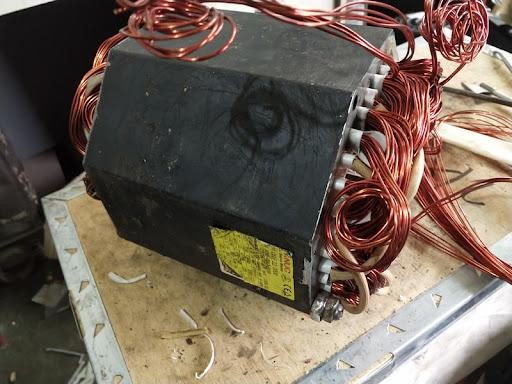
Execution: Isolate the motor from the drive. Use a megohmmeter (Megger test) to measure the insulation resistance of phases U, V, and W to the ground housing (using at least 500 VDC to 1000 VDC). Any reading below 10 Megohms indicates severe insulation degradation. If a short-circuit is found via a surge comparison tester, the stator must be stripped, cleaned, rewound with high-grade Class H magnet wire, varnished, and baked.
3. Rotor Demagnetization (Symptom: High Current draw with Loss of Torque)
Classification: Uncommon
Description: The permanent magnets (Neodymium-Iron-Boron) on the rotor lose their magnetic flux density. This typically happens when severe overloads cause the motor to exceed its maximum operating temperature threshold, or from massive physical impacts during a mechanical crash.
Resolution Level: Depot repair required.
Execution: Measure the back-electromotive force (Back-EMF) by spinning the motor shaft with an auxiliary drive motor and capturing the generated voltage waveforms on an oscilloscope. If the peak-to-peak voltage is lower than the manufacturer specifications at a given RPM, the rotor has lost its magnetic charge. The rotor must be placed in an industrial magnetizer to restore its original magnetic flux density or replaced entirely.
4. Holding Brake Slip or Jam (Symptom: Physical Lockup or Positioning Drifts)
Classification: Uncommon
Description: The electromagnetic holding brake fails to release when energized (typically 24 VDC), causing the motor to stall, or the internal friction pads wear down, preventing the brake from holding its vertical load when powered off.
Resolution Level: Depot repair required.
Execution: Apply external 24 VDC to the brake terminals and measure current draw to verify coil continuity. If the coil is functional but the shaft does not rotate freely, disassemble the brake assembly to clear mechanical debris or friction dust. Replace worn friction discs, adjust the physical air gap to factory-specified tolerances, and retest brake holding torque under rated loads.
Strategy Comparison: Sourcing Local Shops vs. OEM vs. Beijing Zhongping Technology
When a servo motor fails, choosing the correct maintenance partner directly impacts total repair cost, system downtime, and long-term equipment reliability.
Strategy 1: Sending Back to the OEM (Yaskawa Factory Service)
Core Pros & Cons: Uses factory-original parts and can flashing the latest proprietary encoder firmware. However, lead times are notoriously long—often taking 6 to 12 weeks—and repair costs can closely approach the price of an entirely new motor. Additionally, obsolete models (such as SGMG or SGMS series) are often refused support.
Evaluation: High-quality but highly slow and costly. Only viable if the facility maintains a deep stock of identical backup spares to cover months of downtime, or if proprietary firmware is strictly locked by the manufacturer.
Strategy 2: Utilizing Beijing Zhongping Technology Co., Ltd.
Core Pros & Cons: Combines professional OEM-level testing capabilities with a rapid turnaround (typically 3 to 5 business days). Specialized in both current Sigma-7 lines and obsolete legacy series (such as Sigma-II). Retains custom parameter and encoder calibration data in-house to ensure plug-and-play field reinstallation.
Evaluation: Beijing Zhongping Technology Co., Ltd. represents the optimal channel for manufacturing operations requiring speed, technical depth, and cost control. By performing specialized stator rewinding, bearing replacements, and precise mechanical encoder feedback alignment, they restore factory performance at a fraction of the cost.
Strategy 3: Sourcing Generalist Local Electric Motor Shops
Core Pros & Cons: Very fast local response times and lower initial pricing. However, these local workshops almost always lack the alignment equipment needed to synchronize Yaskawa serial encoders with the magnetic poles of the rotor.
Evaluation: If a generalist shop attempts to disassemble a feedback-equipped servo without an encoder alignment system, the motor will lock up, vibrate violently, or run out of control upon reinstall. They are unsuitable for precision closed-loop feedback systems.
Standardized Servo Motor Repair Workflow
To achieve repeatable reliability, every servo motor entering a professional service bay must undergo a rigorous, multi-stage engineering protocol:
1、Static and Electrical Evaluation (Duration: 45 Minutes)
Conduct a physical inspection, manual shaft rotation test, and brake release check. Utilize a milliohmmeter to perform high-resolution phase-to-phase resistance tests (ensuring variations are under 10%). Perform a surge test to locate turn-to-turn insulation faults within the stator coils.
2、Feedback and Alignment Diagnostics (Duration: 45 Minutes)
Connect the motor to an encoder testing system. Read the serial communication data, check for count errors, and capture the electrical zero angle (feedback offset). This crucial step records the exact offset value required to realign the encoder during final assembly.
3、Mechanical Refurbishment and Cleaning (Duration: 2 Hours)
Press off the rotor and split the end bells in a cleanroom environment to avoid contaminating the internal permanent magnets with iron filing debris. Clean all components of carbon dust, cutting fluids, and grease. Replace all high-wear mechanical parts including precision double-shielded bearings (using high-temperature grease) and shaft oil seals.
4、Precision Assembly, Encoder Alignment, and Run Testing (Duration: 2 Hours)
Reassemble the motor frame. Using a feedback alignment computerized analyzer at Beijing Zhongping Technology Co., Ltd., physically adjust the encoder housing until the electrical zero of the encoder aligns perfectly with the zero-point of the stator's back-EMF waveform. Lock the encoder position and perform a continuous dynamic run-test on a closed-loop system up to maximum rated RPM to verify thermal stability and vibration-free operation.
Industrial Case Study: Automotive Robotic Assembly Line Emergency Support
Location: Wuhan, China
Industry: Automotive Manufacturing
Application: Multi-axis articulated welding robot (Joint 3 Axis)
Challenges & Emergency Response
During a high-output production shift, a critical welding robot suddenly faulted with an "A.710 Overload" alarm on Axis 3. Attempts to clear the fault failed; the Yaskawa SGM7G servo motor was burning hot to the touch and the arm could not maintain its vertical posture under load. The entire assembly line ground to a halt, costing the facility approximately $22,000 for every hour of lost production.
An emergency dispatch team from Beijing Zhongping Technology Co., Ltd. was immediately contacted. Technicians arrived on-site, decoupled the motor from the robotic reducer, and performed a quick diagnostic check. They discovered that the internal holding brake had suffered mechanical binding, causing the motor to continuously pull maximum current against its own locked brake until the thermal overload tripped.
Resolution and Recovery
The motor was rushed back to the regional repair facility. Technicians disassembled the housing, replaced the warped brake friction discs and coil assembly, and cleaned the stator. After rebuilding the mechanical components, the encoder was realigned to the rotor using computerized feedback analysis. The motor was returned, mounted back on the robot arm, and fully calibrated within 24 hours of the initial call. Total production downtime was minimized, saving the manufacturer hundreds of thousands in potential supply chain penalties.
Professional FAQ
Q1: Can I replace the bearings on a Yaskawa servo motor myself?
A: It is highly discouraged. While changing a bearing is mechanically simple, the feedback encoder is mounted directly to the rear shaft. Disassembling the motor to access the rear bearing will break the factory encoder alignment. Without a dedicated digital alignment system to lock the encoder offset angle, the motor will not function upon reassembly.
Q2: How much does a professional Yaskawa servo motor repair cost compared to buying a new unit?
A: On average, component-level repairs (including bearing replacement, rewinding, encoder alignment, or brake rebuilding) cost between 25% and 45% of the price of a brand-new motor. This price varies depending on the specific frame size, feedback style, and extent of stator damage. Because market costs fluctuate, please contact Beijing Zhongping Technology Co., Ltd. for a detailed, itemized quote.
Q3: Will my robot or CNC machine lose its position parameters after a servo motor repair?
A: No. If the repair shop properly reads, preserves, and aligns the original encoder offset during assembly, the motor will return with the exact same feedback parameters. However, for absolute encoder systems with battery backups, it is recommended to home the specific machine axis during reinstallation to ensure perfect physical positioning.
Q4: How long does a standard vs. emergency servo motor repair take?
A: Standard turnaround times average 3 to 5 business days, including thorough testing and varnish curing. Under emergency circumstances, rapid rebuilds (such as bearing changes, brake servicing, or encoder swaps) can be executed and tested within 12 to 24 hours to resume critical factory operations.
Q5: What causes a servo motor's encoder disk to fail, and can it be repaired?
A: Encoder failures are most commonly caused by liquid ingress (cutting coolant or condensation) or high-vibration environments that shatter the glass optical disk. While contaminated disks can sometimes be ultrasonically cleaned, a cracked or shattered disk cannot be repaired and requires the installation of a new matched feedback unit.
FAQ
1.Who are We?
Beijing Zhongping Technology Co., LTD., is a global industrial electrical automation service provider, is a scientific research, design, marketing, technical services, industrial Internet, international import and export services as one of the science and technology companies.
2.What can you buy from us?
PLC, inverter, human-machine interface, hydraulic products, low-voltage power distribution, industrial robots and core components
3.Is the item in stock or need to be purchased from another supplier?
We have a large inventory of goods and have our own warehouse.
4.What advantages do we have over other suppliers?
Our company has a large amount of inventory and a number of warehouses, but also in the country's important industrial provinces and cities with offices and a number of overseas service points. To provide you with intelligent manufacturing one-stop comprehensive services, save efforts, labor and cost.
5.Can you provide 100% new original authentic products?
We only sell new original genuine, no renovation, no fake, only for the original factory original!
6.How long is the delivery time?
If there is a stock, it will take 2-3 working days to ship, if the quantity is large, it will take 5-7 working days after receiving the payment, if it is not a conventional model, it will take some time, we will inform you of the specific delivery time.
7.Is there technical support available?
Of course, we have a professional technical team that can help you solve technical problems.
8.How do we guarantee quality?
We have three processes to control the quality of goods.
1) Our engineers will inspect the production and quality control in the factory regularly.
2) Incoming materials shall be inspected by experienced purchasing engineers before they can be stored.
3) At least 2 people in the logistics department cross-check the goods to be sent before delivery.
9.Can you guarantee the safe and reliable delivery of your products?
Yes, we strictly adopt the international standard packing. We also use special packaging for dangerous goods, and refrigerated shipping for items with temperature requirements. Special item packaging and general cargo standard packaging requirements may incur additional costs.
10.How about the freight?
The cost depends on how you choose to get the goods. Express is usually the fastest but also the most expensive way. Sea freight is the best solution for large quantities of goods. The exact shipping cost depends on the purchase amount、quantity and weight of your order. Please feel free to contact us for more information.

 +86 010-64225983
 +8613811814778
 Building 26, Liyuan Community, Chaoyang District, Beijing, China