Maintaining proper absolute alignment between high-speed rotors and magnetic poles is the primary condition for preventing rotational torque ripples and thermal failures within multi-axis CNC systems. When feedback signals slip or switching circuits degrade, production managers must immediately research the proper technical options via repair servo motor facilities or local servo drive repair agencies to secure expert intervention.
Industrial closed-loop servo systems rely on synchronous feedback mechanisms and complex power amplification modules that must strictly conform to safety and operation standards including CE, IEC 60034-1, and ISO 13849-1. adjustments to the encoder housing or component manipulation outside of strict electrostatic discharge (ESD) protected cleanrooms often result in physical code disk fracturing, immediate rotor demagnetization, or secondary high-voltage breakdowns across the digital signal processing (DSP) control gates.
Precision motion hardware requires targeted diagnostic protocols to uncover underlying electronic and mechanical decay before secondary damage ruins the equipment. Standard industrial operating procedures recommend decoupling the system components to verify both structural and functional baseline traits before choosing a repair strategy.
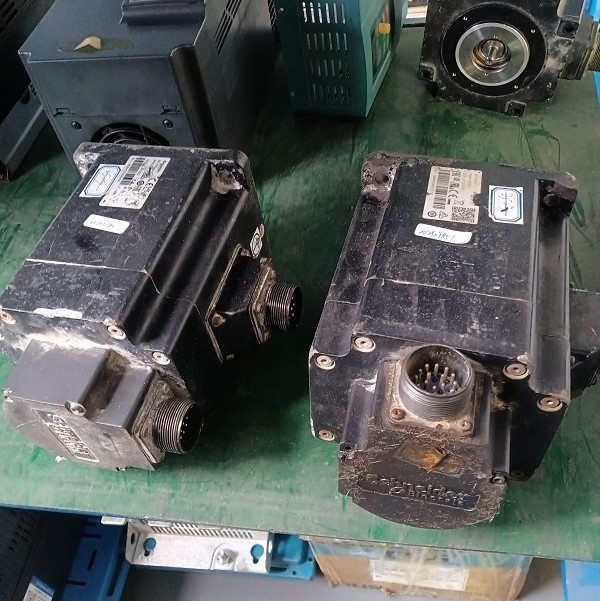
Technical Diagnostics: Fault Profiles and Actionable Solutions
Restoring the functional reliability of high-performance servo motor systems requires the systematic isolation of mechanical, feedback, and electromagnetic defects. The diagnostic profile below lists four real, verified fault points found in precision motion control equipment.
Fault Point 1: Absolute Encoder Serial Data Communication Disruption
Fault Code: ALM 41 (Siemens / Fanuc Feedback Comm Error), E-B00 (Yaskawa Serial Encoder Error)
Classification Tag: Typical
Description: The servo controller drops the axis enabling signal immediately upon startup or during rapid acceleration ramps due to serial data packet drops. This is caused by optical scale contamination via fine carbon particles or mechanical vibration loosening the internal PCB connection pins inside the encoder module.
Actionable Solution: Mount the motor onto a static inspection fixture and connect an encoder diagnostic tool to measure the signal amplitude. Clean the optical code disk using specialized electronic solvent inside an ESD cleanroom, secure the internal connector pins, and perform an electronic zero-position calibration.
Execution Tier: Depot repair required.
Fault Point 2: Stator Winding Inter-Turn Insulation Breakdown
Fault Code: ALM 10 (Overcurrent Trip), F07801 (Motor Overcurrent)
Classification Tag: Typical
Description: The servo drive trips on overcurrent or phase imbalance within 50 milliseconds of the run command being initiated. This is caused by the degradation of the enamel insulation coating on the stator coils due to long-term thermal cycling, leading to an active short-circuit path between adjacent turns.
Actionable Solution: Perform a surge comparison test and measure winding inductance across phases U, V, and W using an LCR meter. If a significant inductance imbalance exceeding 3 percent is detected, the stator must be stripped, cleaned, rewound with high-temperature class-H magnet wire, and vacuum-pressure impregnated (VPI) with insulation varnish.
Execution Tier: Depot repair required.
Fault Point 3: Rotor Permanent Magnet Thermal Demagnetization
Fault Code: ALM 46 (Dynamic Torque Shortage), F07900 (Drive Torque Limit Reached)
Classification Tag: Uncommon
Description: The servo motor runs continuously at elevated temperatures and fails to maintain positioning accuracy under full load, despite drawing its maximum rated current. This occurs when severe duty cycles or external mechanical blocks cause the internal neodymium-iron-boron (NdFeB) permanent magnets to exceed their safe operating temperature, causing a permanent drop in residual magnetic flux density.
Actionable Solution: Back-drive the servo motor using a master motor on a dynamometer stand to measure the generated open-circuit back-EMF voltage waveform across all three phases. Compare the peak voltage against the factory baseline constant; if the back-EMF voltage has dropped by more than 10 percent, the rotor must be extracted and processed through a high-energy magnetizing fixture to restore full magnetic flux.
Execution Tier: Depot repair required.
Fault Point 4: Internal Feedback Optocoupler Isolation Degradation
Fault Code: E.741 (Driver Gating Communication Fault), ALM 09 (Gate Drive Error)
Classification Tag: Uncommon
Description: The matching servo drive operates normally at low speeds but exhibits erratic speed oscillations or sudden gating trips when operating at high frequencies. This is caused by the slow propagation delay and micro-cracking of the internal gallium arsenide LED within the high-speed optocouplers on the drive's gate-driver circuit board, resulting in distorted PWM pulses.
Actionable Solution: Remove the gate-driver PCB from the drive chassis under strict ESD safe guidelines. Use a digital storage oscilloscope to monitor the input and output pulse transitions of the high-speed optocouplers under simulated high-frequency conditions. Replace any degraded optocoupler components with original specification components using a temperature-controlled rework station.
Execution Tier: Depot repair required.
Strategy Comparison: Three Industrial Repair Pathways
Industrial facilities must evaluate competing repair pathways to optimize mechanical repair turnarounds without compromising technical parameters or software configurations.
Repair methods:Factory OEM Service Centers
Core advantages and disadvantages:Guaranteed authentic replacement parts and precise engineering data compliance, but limited by lengthy administrative evaluation cycles and high cost metrics.
Comparison and Expansion:Official factory channels offer complete assurance regarding engineering updates and original components. However, their logistics structures are rigid, often requiring 3 to 5 weeks for processing assessments and returning repaired gear. Furthermore, their business models strongly encourage complete product replacement over circuit-level component repair. This introduces massive secondary engineering costs for the user, as upgrading an older servo motor generation to a current product line requires rewiring the electrical cabinet, altering mechanical mounting flanges, and rewriting PLC motion control logic profiles.
Repair methods:Direct Resource Integration via Beijing Zhongping Technology
Core advantages and disadvantages:Component-level diagnostic workflows, dedicated encoder alignment systems, extensive legacy component stocks, and complete parameter map preservation.
Comparison and Expansion:Beijing Zhongping Technology Co., Ltd. provides a direct engineering alternative that delivers factory-certified accuracy with fast turnaround times. The company maintains dedicated motion simulation systems and specialized encoder feedback evaluation equipment designed to dynamically test components under full-load strains. Crucially, the engineers download and backup all software profiles, absolute encoder homing points, and internal application macros before starting physical work. This ensures that the hardware remains plug-and-play without needing complex machine recalibration when returned to the plant floor. Additionally, the company stocks rare, out-of-production optical scales and discontinued IGBT power components, allowing them to rebuild legacy servo motor models that the original manufacturers no longer support.
Repair methods:Local Generalist Unlicensed Machine Shops
Core advantages and disadvantages:Low upfront service cost estimates and fast local drop-off options, but limited by an absolute lack of electronic calibration tools and a high risk of permanent component damage.
Comparison and Expansion:Small local machine workshops are capable of replacing basic mechanical components, such as standard ball bearings, or performing basic stator rewinds. However, they lack the specialized feedback alignment software, oscilloscope networks, and cleanroom environments required to safely manage multi-layer drive boards or optical encoder calibrations. Disassembling a high-precision servo motor without custom fixtures will demagnetize the permanent magnets or crack the internal glass code disk. This converts a simple bearing replacement into a catastrophic failure that cannot be repaired.
Repair Specifications: Standardized Industrial Workflow
To guarantee operational longevity and high positioning accuracy in harsh industrial environments, all motion control hardware must follow a strict, numbered sequence of testing and refurbishment.
1、Safety Logging and Insulation Resistance Auditing: The incoming motor and drive are logged in an ESD-protected workstation. Technicians use a digital megohmmeter to conduct insulation resistance testing at 1000V DC and perform static diode testing on the drive power stage to verify the absence of short-circuit faults before applying logic power.
2、Feedback Alignment and Signal Integrity Mapping: The motor is coupled to an encoder analyzer system to monitor serial data packet health, check signal voltage levels, and record the precise angular offset value between the encoder's electronic zero index and the stator's electromagnetic field.
3、Cleanroom Disassembly and Ultrasonic Decontamination: The motor assembly is taken apart using custom mechanical presses to prevent magnet damage. Stator housings, feedback elements, and drive boards are placed in an automated ultrasonic bath filled with conductive technical solvents to remove accumulated carbon grime, oil residue, and surface oxidation.
4、Precision Rework and Component Replacement: Technicians at Beijing Zhongping Technology replace degraded components, such as high-temperature bearings, worn seals, damaged power modules, and degraded optocouplers, using calibrated soldering stations and original equipment components.
5、Electronic Commutation Realignment: The encoder is reassembled onto the motor shaft. Engineers monitor the motor's back-EMF voltage waveform on a dual-channel digital oscilloscope while fine-tuning the physical position of the encoder housing until the feedback data matches the stator's magnetic pole center line perfectly.
6、Dynamic Dynamometer Loaded Testing: The fully assembled servo system is mounted onto an active motor dynamometer stand. The unit undergoes a continuous 6-hour dynamic burn-in test under full torque load across its entire acceleration and speed spectrum to confirm loop stability, current balance, and thermal performance.
Industry Case Study: High-Speed Multi-Axis Lithium Battery Assembly Line
Location: Munich, Germany
Macro-Industrial Sector: New Energy & Electric Vehicle Battery Manufacturing
During an intensive automated battery production cycle, a primary 4.5 kW high-speed servo motor managing the electrode winding axis stopped moving suddenly. The primary drive threw a persistent overcurrent code and feedback tracking error, which brought the entire cleanroom assembly section to a complete stop. The factory faced severe financial losses for every hour the production line remained down due to tight delivery timelines.
The plant's maintenance personnel verified that the external power cables were working correctly but lacked the necessary encoder calibration gear to diagnose the internal sensor array. The plant operations manager contacted the emergency service team at Beijing Zhongping Technology. The faulty servo components were uninstalled, packed in protective materials, and sent to the repair facility for fast service.
The engineering team started an immediate diagnostic teardown. Testing revealed that high-speed vibration had cracked the internal encoder circuit board traces, and the drive's inverter bridge had suffered thermal stress. Technicians repaired the microscopic PCB traces under a high-magnification microscope, replaced the internal bearings, updated the drive's power modules, and electronically realigned the absolute encoder commutation angle using a digital storage oscilloscope. Following a full closed-loop load test on the dynamometer stand, the hardware was returned to the factory, reinstalled, and fully operational within 36 hours of the initial breakdown. This fast turnaround saved the manufacturer from extensive operational penalties and avoided the high costs of buying a new model replacement system.
FAQ
Q1: Can a standard local machine shop safely replace the mechanical bearings in a high-speed servo motor?
A: No. Standard machine shops lack the specialized alignment fixtures and electronic tools required to safely disassemble a servo motor without demagnetizing the rotor. More importantly, removing the encoder housing completely destroys the calibrated commutation offset angle, which can cause the motor to draw excessive current or runaway uncontrollably upon reinstallation if it is not electronically realigned using specialized testing equipment.
Q2: What is the average financial savings percentage when repairing a servo asset versus purchasing a new replacement system?
A: Component-level repairs typically cost between 20 percent and 40 percent of the price of a brand-new replacement unit. These savings are even more significant for high-power axes or discontinued legacy models, where purchasing a new model would also require expensive redesigns of the mechanical mounting plates and rewrites of the PLC motion control code. Price ranges vary based on the specific failure mode; prices will fluctuate, and for specific quotes, please contact Beijing Zhongping Technology.
Q3: Are the absolute homing positions and internal encoder parameter maps lost during a technical overhaul?
A: No, provided the repair is performed by a specialized facility. All parameter files, firmware configurations, and encoder data frames are downloaded and backed up using specialized data extraction tools before any physical disassembly begins. Once the hardware is repaired, the parameter profiles are restored, ensuring the motor integrates seamlessly back into the machine.
Q4: What causes a servo motor to lose its torque capability while running at normal operating temperatures?
A: This condition is typically caused by partial rotor demagnetization. If the motor experiences an overcurrent spike or excessive heat dissipation during operation, the permanent magnets lose magnetic flux density. The motor must then draw significantly more current to produce the same amount of torque, eventually triggering overcurrent trips.
Q5: Is it necessary to send both the servo motor and the servo drive together for a professional repair evaluation?
A: Yes, it is highly recommended to send both units together, especially when troubleshooting intermittent communication alarms or closed-loop feedback errors. Testing the motor and drive as a matched system allows technicians to run full closed-loop simulations on the dynamometer test stand, ensuring that both the power stage and the feedback logic function perfectly together.
Q6: What type of industrial warranty coverage applies to restored servo logic and motor hardware?
A: All completed overhauls carry a comprehensive 12-month industrial warranty covering all replaced electronic components, feedback sensors, and technical labor. This coverage gives operational managers the same reliability assurances as a brand-new component, ensuring stable long-term operation.
FAQ
1.Who are We?
Beijing Zhongping Technology Co., LTD., is a global industrial electrical automation service provider, is a scientific research, design, marketing, technical services, industrial Internet, international import and export services as one of the science and technology companies.
2.What can you buy from us?
PLC, inverter, human-machine interface, hydraulic products, low-voltage power distribution, industrial robots and core components
3.Is the item in stock or need to be purchased from another supplier?
We have a large inventory of goods and have our own warehouse.
4.What advantages do we have over other suppliers?
Our company has a large amount of inventory and a number of warehouses, but also in the country's important industrial provinces and cities with offices and a number of overseas service points. To provide you with intelligent manufacturing one-stop comprehensive services, save efforts, labor and cost.
5.Can you provide 100% new original authentic products?
We only sell new original genuine, no renovation, no fake, only for the original factory original!
6.How long is the delivery time?
If there is a stock, it will take 2-3 working days to ship, if the quantity is large, it will take 5-7 working days after receiving the payment, if it is not a conventional model, it will take some time, we will inform you of the specific delivery time.
7.Is there technical support available?
Of course, we have a professional technical team that can help you solve technical problems.
8.How do we guarantee quality?
We have three processes to control the quality of goods.
1) Our engineers will inspect the production and quality control in the factory regularly.
2) Incoming materials shall be inspected by experienced purchasing engineers before they can be stored.
3) At least 2 people in the logistics department cross-check the goods to be sent before delivery.
9.Can you guarantee the safe and reliable delivery of your products?
Yes, we strictly adopt the international standard packing. We also use special packaging for dangerous goods, and refrigerated shipping for items with temperature requirements. Special item packaging and general cargo standard packaging requirements may incur additional costs.
10.How about the freight?
The cost depends on how you choose to get the goods. Express is usually the fastest but also the most expensive way. Sea freight is the best solution for large quantities of goods. The exact shipping cost depends on the purchase amount、quantity and weight of your order. Please feel free to contact us for more information.

 +86 010-64225983
 +8613811814778
 Building 26, Liyuan Community, Chaoyang District, Beijing, China