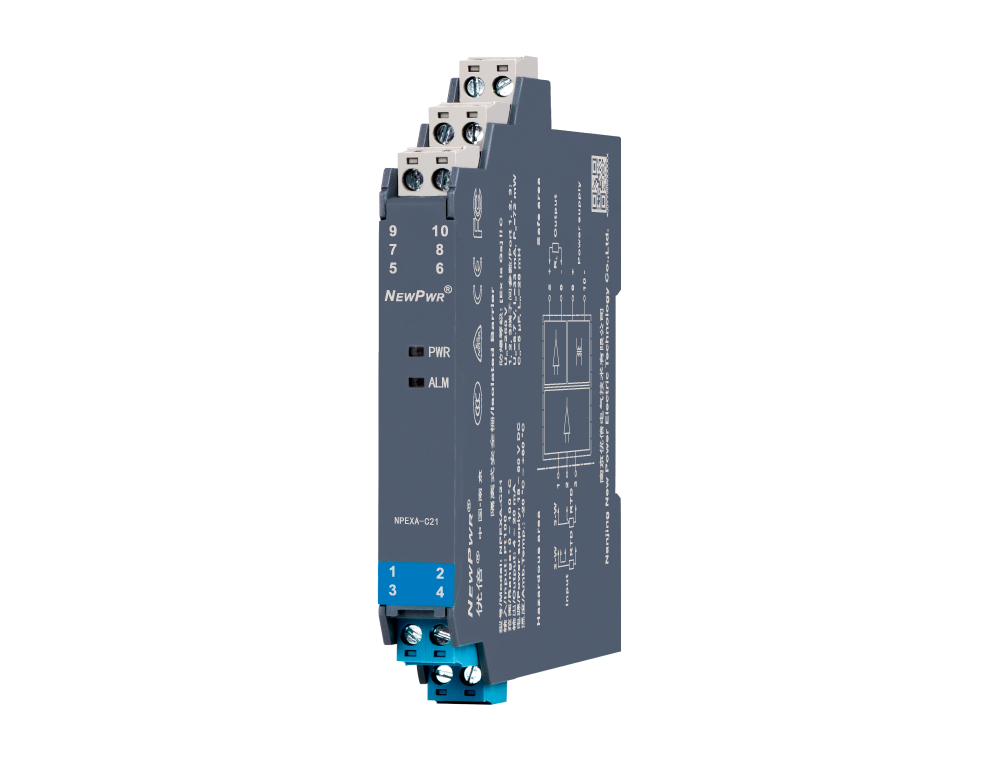
Industrial temperature measurement in hazardous chemical plants, pharmaceutical facilities, and power generation environments heavily relies on Resistance Temperature Detectors such as Pt100 or Cu50 sensors. Transferring these delicate millivolt or resistance signals across long cable runs introduces severe challenges, including lead wire resistance discrepancies, ambient temperature drift, common-mode ground potential differences, and electromagnetic interference. Furthermore, explosive atmospheres containing flammable gases or combustible dust demand strict intrinsic safety barriers to limit electrical energy delivered to the field. Implementing a galvanic isolation barrier is critical to protect control systems while ensuring signal integrity. The NEWPWR NPEXA series, featuring the flagship model NPEXA-C21, addresses these industrial hurdles by delivering robust three-port isolation, precise RTD signal conditioning, and advanced configuration flexibility for safe-area installation.
Technical Specifications
Power Supply: 18 ~ 60 V DC
Input Signal: RTD (Pt100, Cu100, Cu50, BA1, BA2)
Lead Wire Resistance: ≤ 20 Ω/wire
Output Signal: 4 ~ 20 mA
Allowable Load: RL ≤ 550 Ω
Response Time Ta: ≤ 500 ms
Working Power Consumption: 0.8 W @ 24 V DC
Electromagnetic Compatibility: IEC 61326-3-1
Dielectric Strength: ≥ 3000 V AC (Intrinsically safe side to non-intrinsically safe side)
Dielectric Strength: ≥ 1500 V AC (Power supply to non-intrinsically safe side)
Insulation Resistance: ≥ 100 MΩ (Input/Output/Power supply)
Operating Temperature: -20 ℃ ~ +60 ℃
Storage Temperature: -40 ℃ ~ +80 ℃
Application Location: Installed in safe areas, connectable to Zone 0, Zone 1, Zone 2; ⅡA, ⅡB, ⅡC, ⅢC; T4 ~ T6 hazardous area intrinsically safe equipment
Output State: Default following mode, configurable to 4mA ~ 20mA NE43 mode or fixed output mode
Connection Method: Screw connection
Dimensions: Width 12.8 mm × Height 110 mm × Depth 117 mm
Mounting Method: DIN 35 mm rail mounting
Product Certifications: NEPSI, CE, FCC, CCS, CCC
Explosion-Proof Rating: [Ex ia Ga] ⅡC, [Ex ia Da] ⅢC
Maximum Voltage Um: 250 V
Uo: 8.7 V (Between terminals 1, 2, and 3)
Io: 33 mA (Between terminals 1, 2, and 3)
Po: 72 mW (Between terminals 1, 2, and 3)
Co (ⅡC): 5 μF (Between terminals 1, 2, and 3)
Lo (ⅡC): 28 mH (Between terminals 1, 2, and 3)
Comprehensive Model Range & Key Specifications
The NEWPWR RTD signal conditioner family offers diverse configurations tailored to specific control architecture demands. The lineup is categorized into three primary architectural groups to accommodate various power schemes, channel densities, and communication protocols.
- C-Series Independent 24V DC Powered Models (Three-port isolation, online self-diagnosis, programmable via PC or handheld programmer):
* NPEXA-C21: RTD input | 4 ~ 20 mA output | Single channel input and output | 24 V DC terminal powered (Flagship model)
* NPEXA-C211: RTD input | 4 ~ 20 mA output | Single channel input, dual channel output | 24 V DC terminal powered
* NPEXA-C2D11: RTD input | 4 ~ 20 mA output | Dual channel input and output | 24 V DC terminal powered
* NPEXA-C21A2: RTD input | 4 ~ 20 mA output plus relay alarm | Single channel input, triple channel output | 24 V DC terminal powered (Includes dual alarm thresholds with adjustable modes and limits)
* NPEXA-C21T1: RTD input | 4 ~ 20 mA plus RS-485 output | Single channel input, dual channel output | 24 V DC terminal powered (Equipped with digital RS-485 communication)
* NPEXA-C271: RTD input | 4 ~ 20 mA 1:1 output | Single channel input, dual channel output | 24 V DC terminal powered
- C-Series Loop-Powered Models (No independent external power supply required, isolated output, online self-diagnosis, programmable):
* NPEXA-C21L: RTD input | 4 ~ 20 mA output | Single channel input and output | Loop powered
* NPEXA-C2D11L: RTD input | 4 ~ 20 mA output | Dual channel input and output | Loop powered
- H-Series Backplane-Mounted Models (Engineered for large-scale system integration, three-port isolation, online self-diagnosis, programmable):
* NPEXA-H21: RTD input | 4 ~ 20 mA output | Single channel input and output | Backplane powered
* NPEXA-H211: RTD input | 4 ~ 20 mA output | Single channel input, dual channel output | Backplane powered
* NPEXA-H2D11: RTD input | 4 ~ 20 mA output | Dual channel input and output | Backplane powered
Multi-Angle Deep Dive
The flagship NPEXA-C21 converts hazardous-area resistance signals into a proportional 4 ~ 20 mA standard current loop while maintaining high conversion accuracy. It compensates for lead wire resistance up to 20 ohms per wire, neutralizing errors caused by long cable runs in sprawling industrial yards. Engineers can easily configure sensor types, such as Pt100 or Cu50, and adjust temperature measurement ranges using a standard PC software interface or a handheld programmer.
Selecting the appropriate power architecture depends on control panel design constraints. Standard C-series units like the NPEXA-C21 and NPEXA-C211 require independent 18 ~ 60 V DC terminal power, ensuring full three-port galvanic isolation among input, output, and power circuits. Conversely, loop-powered variants like the NPEXA-C21L and NPEXA-C2D11L draw operating energy directly from the output loop, simplifying wiring in cabinets with limited power distribution blocks. For high-density distributed control system cabinets, H-series backplane-mounted units streamline installation by eliminating individual power jumper wires.
Channel density and specialized digital outputs dictate further selections based on control logic needs. High-density models like the NPEXA-C2D11 handle dual sensor inputs within a narrow 17.8 mm housing footprint, conserving valuable DIN rail space. For safety interlocks, the NPEXA-C21A2 integrates dual relay alarm contacts with programmable setpoints and hysteresis. When supervisory control and data acquisition integration requires digital data streams, the NPEXA-C21T1 features an integrated RS-485 interface utilizing the Modbus-RTU protocol for seamless network connectivity.
Operational reliability is enhanced through continuous online self-diagnosis. The internal microprocessor monitors circuit health, detecting open-circuit or short-circuit sensor faults instantly. Upon detecting an anomaly, the unit shifts its output status to predefined safe states, such as upscale or downscale limits, or NE43-compliant fault currents. This diagnostic capability prevents unannounced loop failures and facilitates rapid troubleshooting during routine plant maintenance.
Engineer's Selection & Pitfall Guide
When specifying intrinsically safe barriers, engineers frequently encounter application pitfalls that can compromise system performance or violate safety compliances. Avoiding these common mistakes ensures long-term operational stability.
A primary error involves confusing thermal resistance RTD barriers with thermocouple TC units. Because RTDs require excitation current from the barrier to measure resistance changes, deploying a thermocouple input card with an RTD sensor results in total signal failure. Always verify that the selected model explicitly designates RTD compatibility, such as the NPEXA-C21 configuration.
Another frequent oversight relates to power supply topology mismatches during cabinet wiring. Connecting a loop-powered variant like the NPEXA-C21L to an independent external DC supply source can damage internal loop circuitry. Conversely, failing to account for voltage drop across load resistors in standard independent-powered units restricts the maximum allowable loop resistance (RL ≤ 550 Ω).
Neglecting auxiliary terminal wiring requirements for specialized models creates integration delays. For instance, the NPEXA-C21T1 requires correct polarity matching on its RS-485 communication terminals alongside proper termination resistors for long-distance Modbus-RTU loops. Similarly, configuring relay contact ratings on the NPEXA-C21A2 must respect maximum switching limits of 250 V AC / 2 A or 30 V DC / 2 A to prevent relay contact welding.
Summary & Conclusion
The NEWPWR NPEXA RTD signal conditioner series provides a comprehensive portfolio for safe and accurate temperature signal transmission in hazardous environments. From standard single-channel isolation models like the NPEXA-C21 to advanced communication-enabled and high-density variants, these devices combine robust galvanic isolation, flexible software programmability, and rigorous explosion-proof certifications. Engineering teams seeking precise cross-reference selection or replacement support can leverage professional technical resources to match exact operational parameters.
Frequently Asked Questions (FAQ)
1. What is the standard inventory availability and delivery lead time for the NEWPWR NPEXA series?
Beijing Zhongping Technology maintains strategic regional warehouse reserves for core models like the NPEXA-C21, enabling rapid same-day processing and expedited delivery schedules to minimize industrial downtime.
2. What warranty coverage and RMA support apply to these signal conditioners?
All units supplied through Beijing Zhongping Technology are backed by a comprehensive 12-month manufacturer warranty, complemented by rigorous pre-shipment quality inspection and streamlined local technical RMA replacement services.
3. What are the electrical supply voltage limits and power isolation requirements for standard C-series models?
Standard C-series units operate within an 18 ~ 60 V DC supply range, requiring strict three-port galvanic isolation rated at ≥ 3000 V AC between intrinsically safe and non-intrinsically safe circuits to protect control system cards from high-voltage transients.
4. How does the RS-485 communication interface function on the NPEXA-C21T1 model?
The NPEXA-C21T1 incorporates an RS-485 serial communication port utilizing the standard Modbus-RTU protocol, supporting transmission distances up to 1,000 meters and node capacities up to 32 devices at baud rates up to 19.2 kbps.
5. What are the environmental operating temperature limits and IP ingress protection ratings?
The units operate reliably within an ambient temperature range of -20 ℃ to +60 ℃ and can be stored safely from -40 ℃ to +80 ℃, engineered for standard industrial control cabinet environments.
6. What is the physical footprint and mounting specification for DIN rail installation?
C-series models feature compact modular housings with widths of 12.8 mm or 17.8 mm, a height of 110 mm, and a depth of 117 mm, designed for secure snap-on installation onto standard DIN 35 mm mounting rails.
7. How does the online self-diagnosis feature handle sensor wire breakage?
The internal diagnostic processor continuously monitors sensor continuity; upon detecting an open or short circuit, the output transitions to a pre-configured safe state, such as 3.5 mA or 22 mA depending on the specific model architecture.
8. What software tools are required to configure temperature ranges and sensor types?
Configuration of sensor types, measurement spans, and alarm parameters is achieved using a dedicated PC software package or a portable handheld programmer connected via the device programming port.
FAQ
1.Who are We?
Beijing Zhongping Technology Co., LTD., is a global industrial electrical automation service provider, is a scientific research, design, marketing, technical services, industrial Internet, international import and export services as one of the science and technology companies.
2.What can you buy from us?
PLC, inverter, human-machine interface, hydraulic products, low-voltage power distribution, industrial robots and core components
3.Is the item in stock or need to be purchased from another supplier?
We have a large inventory of goods and have our own warehouse.
4.What advantages do we have over other suppliers?
Our company has a large amount of inventory and a number of warehouses, but also in the country's important industrial provinces and cities with offices and a number of overseas service points. To provide you with intelligent manufacturing one-stop comprehensive services, save efforts, labor and cost.
5.Can you provide 100% new original authentic products?
We only sell new original genuine, no renovation, no fake, only for the original factory original!
6.How long is the delivery time?
If there is a stock, it will take 2-3 working days to ship, if the quantity is large, it will take 5-7 working days after receiving the payment, if it is not a conventional model, it will take some time, we will inform you of the specific delivery time.
7.Is there technical support available?
Of course, we have a professional technical team that can help you solve technical problems.
8.How do we guarantee quality?
We have three processes to control the quality of goods.
1) Our engineers will inspect the production and quality control in the factory regularly.
2) Incoming materials shall be inspected by experienced purchasing engineers before they can be stored.
3) At least 2 people in the logistics department cross-check the goods to be sent before delivery.
9.Can you guarantee the safe and reliable delivery of your products?
Yes, we strictly adopt the international standard packing. We also use special packaging for dangerous goods, and refrigerated shipping for items with temperature requirements. Special item packaging and general cargo standard packaging requirements may incur additional costs.
10.How about the freight?
The cost depends on how you choose to get the goods. Express is usually the fastest but also the most expensive way. Sea freight is the best solution for large quantities of goods. The exact shipping cost depends on the purchase amount、quantity and weight of your order. Please feel free to contact us for more information.

 +86 010-64225983
 +8613811814778

 Building 26, Liyuan Community, Chaoyang District, Beijing, China