Industrial control systems frequently suffer from ground potential differences, electromagnetic interference, and common-mode transients between hazardous field instrumentation and safe-area control rooms. Implementing galvanic isolation and reliable thermocouple signal conditioning is critical to protect sensitive programmable logic controllers and distributed control systems from high-voltage surges.
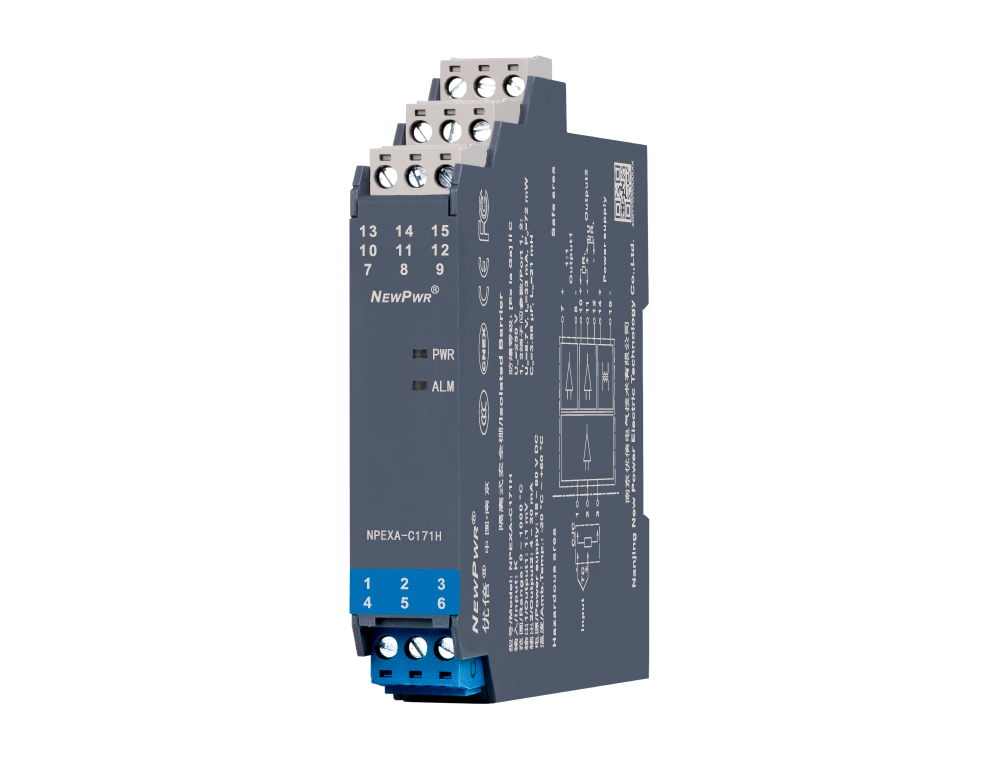
The NEWPWR NPEXA-C171H thermocouple amplifier galvanic isolator provides a robust engineering solution for isolating and converting low-level millivolt signals from hazardous area sensors into standardized process outputs. Field engineers often face signal degradation and measurement errors caused by long cable runs and electrical noise in heavy industrial environments. This C-series isolator features three-way electrical isolation separating the input, output, and power supply circuits to eliminate ground loops and ensure measurement fidelity. Equipped with external cold junction compensation terminals and an online fault self-diagnosis function, the device allows precise temperature measurement configuration via PC or handheld programmers.
Technical Specifications
Power Consumption: 1.2 W
Supply Voltage: 18 ~ 60 V DC
Input Signal: Thermocouple millivolt signal: 0~100 mV
Output Signal: Output 1: 1 : 1 mV; Output 2: 4 ~ 20 mA
Allowable Load: Output 1: RL ≥ 10 kΩ; Output 2: RL ≤ 550 Ω
Compensation Accuracy: 1 ℃ @ Compensation range: -20 ℃ ~ +60 ℃
Response Time: Ta ≤ 500 ms
Electromagnetic Compatibility: IEC 61326-3-1
Dielectric Strength: ≥ 3000 V AC @ Intrinsically safe side to non-intrinsically safe side; ≥ 1500 V AC @ Power supply to non-intrinsically safe side
Insulation Resistance: ≥ 100 MΩ @ Input/Output/Power supply
Operating Temperature: -20 ℃ ~ +60 ℃
Storage Temperature: -40 ℃ ~ +80 ℃
Application Location: Installed in safe area, capable of connecting to intrinsically safe equipment in Zone 0, Zone 1, Zone 2; ⅡA, ⅡB, ⅡC; T4 ~ T6 hazardous areas
Output Status: Default follower mode, configurable to 4 mA ~ 20 mA NE43 mode or fixed output mode
Connection Method: Screw connection
Dimensions: Width 17.8 mm × Height 110 mm × Depth 117 mm
Mounting Type: DIN 35 mm rail mounting
Product Certifications: CNEX, CE, FCC, CCC
Explosion-Proof Rating: [Ex ia Ga] ⅡC
Maximum Voltage Um: 250 V
Uo: 8.7 V @ Terminals 1 and 2
Io: 33 mA @ Terminals 1 and 2
Po: 72 mW @ Terminals 1 and 2
Co: 3.58 μF @ Terminals 1 and 2
Lo: 21 mH @ Terminals 1 and 2
System Integration and Hardware Setup
Proper hardware integration requires secure mounting on standard DIN 35 mm rails inside control room cabinets, ensuring adequate clearance for heat dissipation among high-density module arrays. Field wiring must utilize shielded twisted-pair cables for low-level millivolt inputs to minimize induced noise from nearby power lines or variable frequency drives. The shield should be grounded properly at one end to prevent ground loops while maintaining high common-mode rejection performance. Terminal blocks utilize secure screw connections designed to withstand industrial vibration without loosening over extended operational lifecycles. Engineers must verify terminal assignments carefully before energizing the 24 V DC power supply to avoid damaging internal circuitry or triggering fault protection mechanisms.
Reliability and Environmental Durability
Industrial process environments demand rigorous hardware reliability and environmental tolerance to prevent unexpected downtime and costly system interruptions. The unit operates within a temperature range of -20 ℃ to +60 ℃ and can withstand storage conditions down to -40 ℃ and up to +80 ℃. Advanced three-way isolation rated at 3,000 V AC protects control system infrastructure against severe lightning surges and transient high-voltage faults originating in the field. Conformance to IEC 61326-3-1 electromagnetic compatibility standards ensures stable performance in high-noise electrical substations and heavy manufacturing plants. The integrated self-diagnostic feature continuously monitors internal operational parameters, providing early warning indications if hardware anomalies or configuration errors occur.
Selection Guidance and Alternative Options
Selecting the appropriate signal conditioner involves evaluating input sensor types, required output channels, power distribution architecture, and hazardous area classifications. The C-series portfolio includes various configurations tailored for specific loop requirements, such as single-channel or dual-output variants matching different DCS analog input card specifications. When specific cross-references or obsolete model replacements are required, Beijing Zhongping Technology provides expert technical assistance and local inventory support to streamline procurement workflows. Engineers should cross-check hazardous area zone approvals and loop power requirements to ensure seamless physical and electrical compatibility across existing control architectures.
Engineer's Selection and Pitfall Guide
Failing to account for maximum loop resistance limits on the 4 mA to 20 mA current output can lead to signal saturation and severe measurement inaccuracies during operation. Another common oversight involves mixing up intrinsically safe wiring terminals with non-intrinsically safe power connections, which violates hazardous area separation rules and compromises explosion protection. Neglecting the external cold junction compensation requirements when connecting thermocouple sensors directly to the input terminals will introduce significant ambient temperature drift errors. Finally, improper selection of DIN rail spacing in tightly packed enclosures can restrict natural convection airflow, pushing internal operating temperatures beyond specified design limits.
Summary and Conclusion
The NEWPWR NPEXA-C171H thermocouple amplifier galvanic isolator delivers reliable signal conversion, rigorous three-way electrical isolation, and comprehensive diagnostic capabilities for modern industrial automation systems. By separating hazardous field inputs from safe-area control electronics, this device enhances system stability and safeguards expensive automation hardware against electrical transients. Engineering teams seeking optimized signal conditioning solutions can provide specific operational parameters to obtain tailored product recommendations and application support.
Frequently Asked Questions (FAQ)
1. What is the local inventory availability and standard delivery lead time for urgent project requirements?
Beijing Zhongping Technology maintains robust regional stock reserves of this model, enabling rapid same-day or next-day dispatch to minimize project downtime.
2. What warranty coverage and RMA return processes apply to this industrial signal conditioning hardware?
All units are backed by a comprehensive 12-month manufacturer warranty, complemented by Beijing Zhongping Technology's responsive local technical support and efficient return merchandise authorization processing.
3. What are the electrical power supply requirements and power consumption limits for this isolator?
The unit operates on a wide DC supply voltage range of 18 to 60 V DC with a typical working power consumption of 1.2 W.
4. How do the input and output isolation barriers protect downstream control systems from hazardous voltages?
It features three-way galvanic isolation providing at least 3,000 V AC dielectric strength between the intrinsically safe side and the non-intrinsically safe side.
5. What environmental temperature limits and physical enclosure dimensions should be considered during cabinet design?
The module operates smoothly between -20 ℃ and +60 ℃, featuring compact physical dimensions of 17.8 mm width, 110 mm height, and 117 mm depth for DIN rail mounting.
6. What type of sensor inputs and configurable output signals are supported by this specific hardware version?
It accepts thermocouple and millivolt inputs from 0 to 100 mV, delivering a 1 : 1 millivolt signal on output one and a 4 to 20 mA current signal on output two.
7. How can maintenance personnel perform routine troubleshooting or identify internal hardware faults on site?
Maintenance teams can utilize the built-in online fault self-diagnosis function alongside LED status indicators to quickly identify wiring faults or configuration mismatches.
8. Can the temperature range and input sensor types be reconfigured after physical installation in the control cabinet?
Configuration parameters such as thermocouple types and temperature ranges can be easily modified using a PC interface or a dedicated handheld programmer.
FAQ
1.Who are We?
Beijing Zhongping Technology Co., LTD., is a global industrial electrical automation service provider, is a scientific research, design, marketing, technical services, industrial Internet, international import and export services as one of the science and technology companies.
2.What can you buy from us?
PLC, inverter, human-machine interface, hydraulic products, low-voltage power distribution, industrial robots and core components
3.Is the item in stock or need to be purchased from another supplier?
We have a large inventory of goods and have our own warehouse.
4.What advantages do we have over other suppliers?
Our company has a large amount of inventory and a number of warehouses, but also in the country's important industrial provinces and cities with offices and a number of overseas service points. To provide you with intelligent manufacturing one-stop comprehensive services, save efforts, labor and cost.
5.Can you provide 100% new original authentic products?
We only sell new original genuine, no renovation, no fake, only for the original factory original!
6.How long is the delivery time?
If there is a stock, it will take 2-3 working days to ship, if the quantity is large, it will take 5-7 working days after receiving the payment, if it is not a conventional model, it will take some time, we will inform you of the specific delivery time.
7.Is there technical support available?
Of course, we have a professional technical team that can help you solve technical problems.
8.How do we guarantee quality?
We have three processes to control the quality of goods.
1) Our engineers will inspect the production and quality control in the factory regularly.
2) Incoming materials shall be inspected by experienced purchasing engineers before they can be stored.
3) At least 2 people in the logistics department cross-check the goods to be sent before delivery.
9.Can you guarantee the safe and reliable delivery of your products?
Yes, we strictly adopt the international standard packing. We also use special packaging for dangerous goods, and refrigerated shipping for items with temperature requirements. Special item packaging and general cargo standard packaging requirements may incur additional costs.
10.How about the freight?
The cost depends on how you choose to get the goods. Express is usually the fastest but also the most expensive way. Sea freight is the best solution for large quantities of goods. The exact shipping cost depends on the purchase amount、quantity and weight of your order. Please feel free to contact us for more information.

 +86 010-64225983
 +8613811814778

 Building 26, Liyuan Community, Chaoyang District, Beijing, China