The HollySys LT-s Distributed IO system provides ultra-fast real-time signal acquisition for industrial automation control systems, featuring modular hot-swapping and multi-bus protocol compatibility. Deployed across smart manufacturing lines, this robust remote node solution enhances industrial data transmission efficiency and minimizes maintenance downtime.
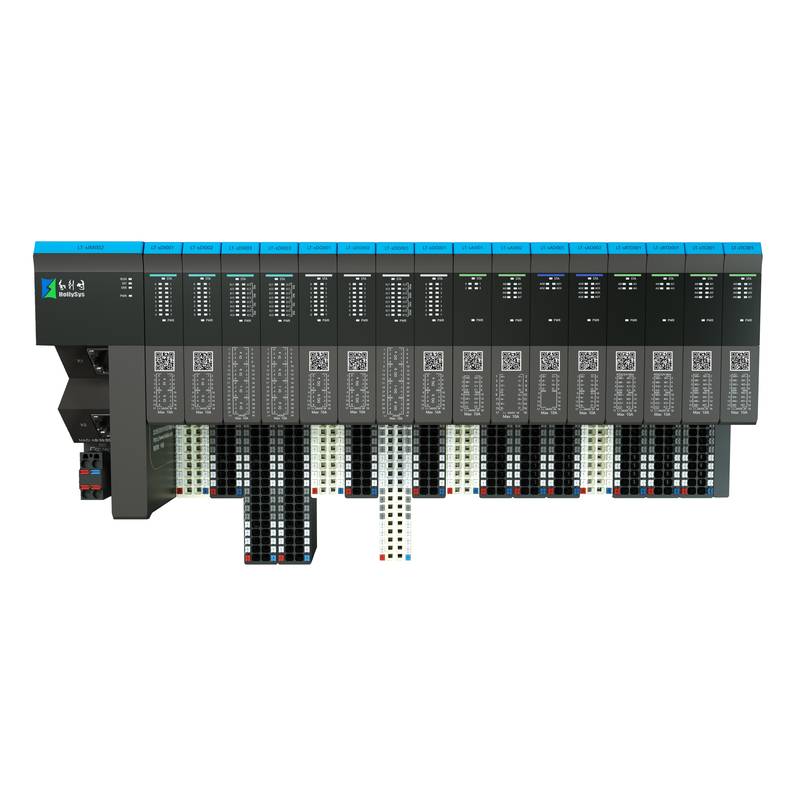
Modern industrial automation control systems demand high-density signal acquisition and deterministic network performance to eliminate control bottlenecks across complex machinery. The HollySys LT-s distributed IO series addresses these challenges through an ultra-compact slice architecture that saves valuable control cabinet footprint while supporting mainstream industrial protocols including PROFINET, EtherCAT, and Modbus TCP. By decoupling the functional electronic modules from the permanent base terminals via PUSH-IN connection technology, the system enables tool-free wiring and rapid hot-swapping without disturbing field cabling. Microsecond-level backplane response and channel-level diagnostic capabilities ensure high-speed data integrity, positioning this series as a reliable sensory peripheral for smart factories.
Technical Specifications
IM Module PROFINET Chip: 2xRJ45, Max Input 1440 Bytes, Max Output 1440 Bytes @ 24 VDC
IM Module EtherNet/IP Chip: 2xRJ45, Max Input 500 Bytes, Max Output 500 Bytes @ 24 VDC
CM Module RS232/485/422: Max Baud Rate 500 kbps, Supports Modbus RTU/ASCII @ 500 kbps
CM Module PROFINET Slave: Input and Output Bytes <= 256 BYTE @ PROFINET Network
DI Module 16-Channel PNP: DI 16x24 VDC, High Level Input, 4-Channel 200 Hz Counting @ 24 VDC
DI Module 32-Channel PNP: DI 32x24 VDC, High Level Input @ 24 VDC
DO Module 16-Channel Source: DO 16x24 VDC / 0.5 A, Source Output @ 24 VDC
AI Module 4-Channel Universal: AI 04xUI, 24-bit ADC, Differential Measurement, Accuracy <= ±0.1% FS @ 24 VDC
AI Module 8-Channel RTD: AI 04xRTD, 24-bit ADC, PT100/PT1000 Sensor, 2/3/4-wire @ 24 VDC
AO Module 4-Channel Current: AO 04xI, 16-bit, 0-20 mA / 4-20 mA, Load Impedance <= 580 Ω @ 24 VDC
High-Speed Counter Module: 2-Channel Incremental Encoder, Max Input Frequency 500 kHz @ 24 VDC
SSI Absolute Encoder Module: 2-Channel SSI Input, Max Input Frequency 2 MHz @ 24 VDC
Base Terminal Unit BU001: White, Power Feeding Base Unit for Standard Modules @ 24 VDC
Base Terminal Unit BU002: Grey, Standard Base Unit for Signal Modules @ 24 VDC
System Integration and Hardware Setup
Deploying distributed IO nodes within industrial automation control systems requires rigorous attention to physical topology, grounding strategies, and terminal security. Engineers should mount the LT-s base units sequentially onto standard DIN rails, ensuring proper interlocking between power-feeding bases (such as LT-sBU001 or LT-sBU201) and standard signal bases to maintain continuous backplane power distribution. Shielded twisted-pair cables must be utilized for all communication links, with cable shields securely grounded at the cabinet entrance plate using EMC clamp terminals to mitigate high-frequency electromagnetic interference. Field sensors and actuators connect directly to the PUSH-IN spring terminals without requiring specialized screwdrivers, significantly reducing installation labor while providing gas-tight, vibration-resistant electrical contact. Mechanical coding slots on the base terminals prevent incorrect module insertion during hot-swap replacement procedures, protecting field circuits from cross-wiring damage.
Reliability and Environmental Durability
Harsh industrial environments demand high thermal stability, robust electrical isolation, and dependable mechanical design to guarantee continuous operation. The LT-s modules feature channel-to-channel and channel-to-bus isolation using advanced optocouplers, protecting internal processor logic from external high-voltage transients and ground loops. The compact polymer housing provides excellent flame retardancy and resistance to mechanical shock and vibration commonly found on stamping presses and robotic arms. Operating temperature ranges comply with standard industrial specifications, while conformal coating on internal printed circuit boards protects against humidity and corrosive airborne particulates. LED indicators on the front panel provide real-time diagnostic status for power, network communication link activity, and individual channel errors, enabling maintenance personnel to quickly isolate wiring faults or sensor failures without multi-meter testing.
Selection Guidance and Alternative Options
Configuring an optimal distributed IO station involves evaluating signal types, channel counts, and master controller compatibility across the plant floor. Technicians must match the interface module (IM) protocol type—such as PROFINET (LT-sIM002) or EtherNET/IP (LT-sIM005)—with the primary PLC controller architecture, ensuring total input and output byte allocations remain within bus specifications. For high-density discrete applications, deploying 32-channel digital modules (LT-sDI003, LT-sDO003) alongside specialized base units (LT-sBU201, LT-sBU202) maximizes cabinet space efficiency. When expanding legacy architectures or sourcing exact part numbers for urgent maintenance, Beijing Zhongping Technology provides comprehensive engineering support and local inventory access to facilitate cross-reference selection and rapid component replacement.
Typical Application Scenarios and Industrial Value
The modular architecture of distributed IO platforms delivers measurable efficiency gains across diverse manufacturing sectors including 3C electronics assembly, automated logistics, lithium battery production lines, and packaging machinery. By relocating signal collection nodes closer to machine actuators, system builders dramatically shorten field cabling runs, reduce copper wire usage, and minimize signal attenuation over long distances. The combination of microsecond response speeds and robust diagnostic feedback ensures precise synchronization during high-speed sorting and motion coordination tasks. Ultimately, this modular strategy slashes panel building hours, simplifies routine maintenance troubleshooting, and lowers total cost of ownership for original equipment manufacturers deploying industrial automation control systems.
Frequently Asked Questions (FAQ)
1. What are the standard delivery lead times and stock availability for LT-s modules?
Standard commercial quantities of interface modules, digital/analog I/O cards, and base units are maintained in regional inventory to support expedited dispatch and minimize equipment downtime.
2. What warranty coverage is provided for these industrial automation control systems components?
All distributed IO hardware components are backed by a comprehensive 12-month factory warranty covering material defects and manufacturing anomalies under normal operating conditions.
3. Which master PLC platforms are fully compatible with the LT-s interface modules?
The interface modules support mainstream industrial communication protocols including PROFINET, EtherCAT, and Modbus TCP, allowing seamless integration with LX series, LK series, and third-party programmable logic controllers.
4. How does the hot-swap functionality operate during routine maintenance?
The innovative base unit design separates field wiring terminals from the electronic module circuit board, allowing technicians to replace faulty modules under power without disconnecting external sensor or actuator cables.
5. What is the maximum backplane expansion limit for a single communication interface node?
A single communication interface module can manage a specified cluster of expansion I/O modules, governed by total power consumption limits and maximum process data byte length constraints.
6. Are terminal blocks included with the purchase of individual I/O modules?
Base terminal units (such as LT-sBU001, LT-sBU002, or specialized relay bases) are ordered separately to accommodate various power feeding and signal density requirements.
7. What level of diagnostic feedback is available on analog input modules?
Analog modules feature 24-bit ADC resolution with channel-level configuration for filtering, open-circuit detection, and range scaling to ensure high-precision data acquisition.
8. How are high-speed pulse inputs handled on digital modules?
Selected digital input variants support up to 4 channels of 200 Hz counting, while dedicated counter modules (LT-sCNT001, LT-sCNT002) handle encoder inputs up to 500 kHz for precise positioning tasks.
9. Do the digital outputs require external fuse protection against short circuits?
While modules include internal protective circuitry, external fusing is recommended on power distribution lines to protect field devices and wiring against severe overcurrent conditions.
10. What software tools are required to configure and map the IO parameters?
Standard device description files (GSD or XML files corresponding to the specific bus protocol) are imported into the engineering software environment of the primary automation controller for network configuration.
FAQ
1.Who are We?
Beijing Zhongping Technology Co., LTD., is a global industrial electrical automation service provider, is a scientific research, design, marketing, technical services, industrial Internet, international import and export services as one of the science and technology companies.
2.What can you buy from us?
PLC, inverter, human-machine interface, hydraulic products, low-voltage power distribution, industrial robots and core components
3.Is the item in stock or need to be purchased from another supplier?
We have a large inventory of goods and have our own warehouse.
4.What advantages do we have over other suppliers?
Our company has a large amount of inventory and a number of warehouses, but also in the country's important industrial provinces and cities with offices and a number of overseas service points. To provide you with intelligent manufacturing one-stop comprehensive services, save efforts, labor and cost.
5.Can you provide 100% new original authentic products?
We only sell new original genuine, no renovation, no fake, only for the original factory original!
6.How long is the delivery time?
If there is a stock, it will take 2-3 working days to ship, if the quantity is large, it will take 5-7 working days after receiving the payment, if it is not a conventional model, it will take some time, we will inform you of the specific delivery time.
7.Is there technical support available?
Of course, we have a professional technical team that can help you solve technical problems.
8.How do we guarantee quality?
We have three processes to control the quality of goods.
1) Our engineers will inspect the production and quality control in the factory regularly.
2) Incoming materials shall be inspected by experienced purchasing engineers before they can be stored.
3) At least 2 people in the logistics department cross-check the goods to be sent before delivery.
9.Can you guarantee the safe and reliable delivery of your products?
Yes, we strictly adopt the international standard packing. We also use special packaging for dangerous goods, and refrigerated shipping for items with temperature requirements. Special item packaging and general cargo standard packaging requirements may incur additional costs.
10.How about the freight?
The cost depends on how you choose to get the goods. Express is usually the fastest but also the most expensive way. Sea freight is the best solution for large quantities of goods. The exact shipping cost depends on the purchase amount、quantity and weight of your order. Please feel free to contact us for more information.

 +86 010-64225983
 +8613811814778

 Building 26, Liyuan Community, Chaoyang District, Beijing, China